
Globally, non-profits spend an average of just 2% of their entire annual budget on technology. The private sector spends more than 12%. That 2% has become a trap: low enough to feel acceptable, high enough to feel like "we're doing something" — but nowhere near what it takes to run programs that actually work.
In India it gets harder. FCRA Rule 5 caps the amount NGOs can spend on IT as administrative cost, and most funders treat technology as overhead — a cost to cut, not infrastructure to protect. The result: over 80% of Indian NGOs score poorly on digital readiness. That is not a coincidence. It is a structural problem.
You've felt this, even if you haven't named it
Your field staff is doing data entry twice. Your MIS is exporting to spreadsheets just to "fix" the numbers. Your program head is making decisions on last quarter's data because nobody had time to clean this quarter's. That's not a people problem. That's a tech-budget problem.
If your 50-member team loses just 30 minutes a day to broken systems, that's 3,125 hours a year — gone. The cost doesn't show up in your budget. It shows up in your team's exhaustion, in communities that stop trusting the organisations meant to serve them, and in decisions made on guesswork.
The one number you need to know: 5%
That's what your annual technology budget should be, at a minimum. Not 1%. Not "whatever's left over." 5% of your operating budget, reviewed every year, treated as policy — not a wish list.
Where does that 5% actually go?
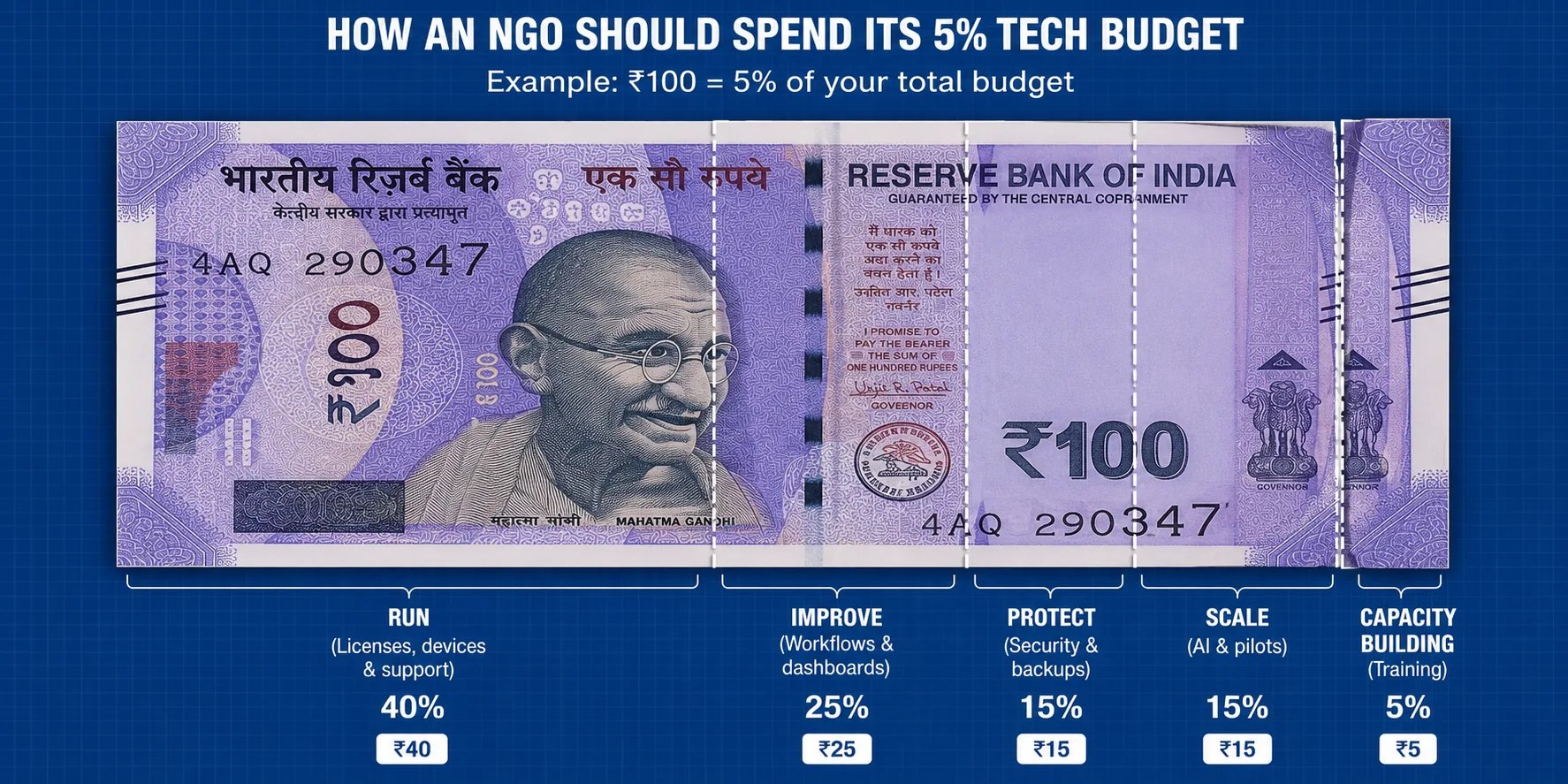
Split your tech budget into five buckets. Each one does a different job, and each comes with a litmus test you can use to spot where you're under-invested.
Run — 40% · Keep the lights on
Your baseline: the tools your team uses every single day — core software (MIS, CRM, accounting, HRMS), cloud storage and hosting, laptops, tablets and shared smartphones for field teams, connectivity reimbursements, and basic IT support. This bucket must reflect Indian realities: shared devices, patchy rural connectivity, WhatsApp-first behaviour, government reporting duplication.
Litmus test: if your field team spends 30 extra minutes a day fighting a slow workflow, your Run bucket is underfunded.
Improve — 25% · Make the system work for your team
Most NGOs digitise their existing workflows without redesigning them, so the chaos just moves into a new interface. This bucket funds the thinking work: redesigning workflows with program teams, integrating MIS and finance tools so data isn't duplicated, automating repetitive reporting, and building dashboards that reflect decision needs — not donor templates.
Litmus test: if your team is exporting data into spreadsheets to "fix" the system, you're underinvesting here.
Protect — 15% · One breach can erase a decade of trust
Your organisation holds Aadhaar-linked beneficiary data, health records, and child-protection cases — often with no structured access controls, no backup policy, and shared passwords. This bucket covers role-based access, automated backups, annual security audits, basic cyber-hygiene training, and password managers.
Litmus test: when someone questions the cybersecurity line item while your systems hold sensitive citizen data, show them what a breach actually costs.
Scale — 15% · Experiment, but only on real problems
AI belongs here — but only when it solves a named problem, not because it's trending. Think AI call summarisation for field helplines, voice-to-text reporting for low-literacy staff, dropout-risk models for education programs, or chatbot pilots to reduce hotline load.
Litmus test: every experiment must answer — what bottleneck are we solving, whose problem is it, what defines adoption, and what's the plan if it works? If your team doesn't come back to it voluntarily after the first week, shut it down.
Capacity Building — 5% · Your tech is only as good as the people using it
The most underfunded bucket in the sector. Tools fail not because they're bad, but because no one was trained to use them, champion them, or adapt them when the context changed. This covers staff training, change management during transitions, internal tech champions, and peer exchanges on digital practice.
Litmus test: what happens the week after your implementation vendor offboards? If the answer is silence and workarounds, you don't have a tech problem — you have no internal owner.
Three steps to make it real
1. Map what you're actually spending. You'll likely find something like 65% on Run, 25% on random pilots, 5% on Improve, and nothing on Protect. That imbalance is what's causing the unfruitful results.
2. Give each bucket a named owner. COO owns Run, Program Head owns Improve, Finance owns Protect, Strategy Lead owns Scale. When everyone owns it, no one does.
3. Review it quarterly. Tech moves faster than grant cycles. Your budget discipline has to as well.
If you're a funder, this is for you
This problem cannot be fixed by NGOs alone; the structure has to change. Stop thinking of technology as overhead — tech that enables program delivery is mission expenditure. Offer a dedicated tech line in your grants; even 3% changes what's possible for a team. And ask the right question in due diligence: not "do you have an MIS?" but "does your MIS reduce your team's workload or add to it?"
Why 5% and not 10%?
Because 5% is a realistic first move, not the final destination. Most Indian NGOs sit at 1–2% today; asking them to leap to 10% in a single budget cycle is a wish, not a policy. 5% is a deliberate, defensible ask that shifts the sector's default without triggering funder pushback.
One nuance: 5% is a maintenance budget. It keeps functional systems running and improving. If your organisation has never invested properly in technology, digital transformation is a multi-year investment that needs additional one-time capital, change management, and new hires. The 5% rule is where you sustain.
Why now?
March and April are India's nonprofit budget season. Boards are approving annual plans, funders are reviewing grant frameworks, program heads are making the case for next year's priorities. This is the window to make a structural argument for technology as mission infrastructure — before the budget is locked. If the conversation doesn't happen now, it gets deferred another year. And another 3,125 hours walk out the door.
A note for smaller NGOs
If your annual budget is under ₹50 lakh, the 5% rule is a floor, not a ceiling. Smaller organisations often get more impact per rupee from technology — better data systems, less duplication, faster reporting. If you're running lean, spending 8–10% on tech may be the highest-leverage decision you make this year. The benchmark is designed to move the sector's average upward; for those already working with limited resources, the ask is to prioritise, not minimise.
The next time a program budget lands on your desk, ask one question before you sign it: are the systems that will run this program funded with the same care as the program itself? If not, the program is already underfunded — whether the numbers say so or not. Technology stops being overhead the moment you stop treating it that way.