
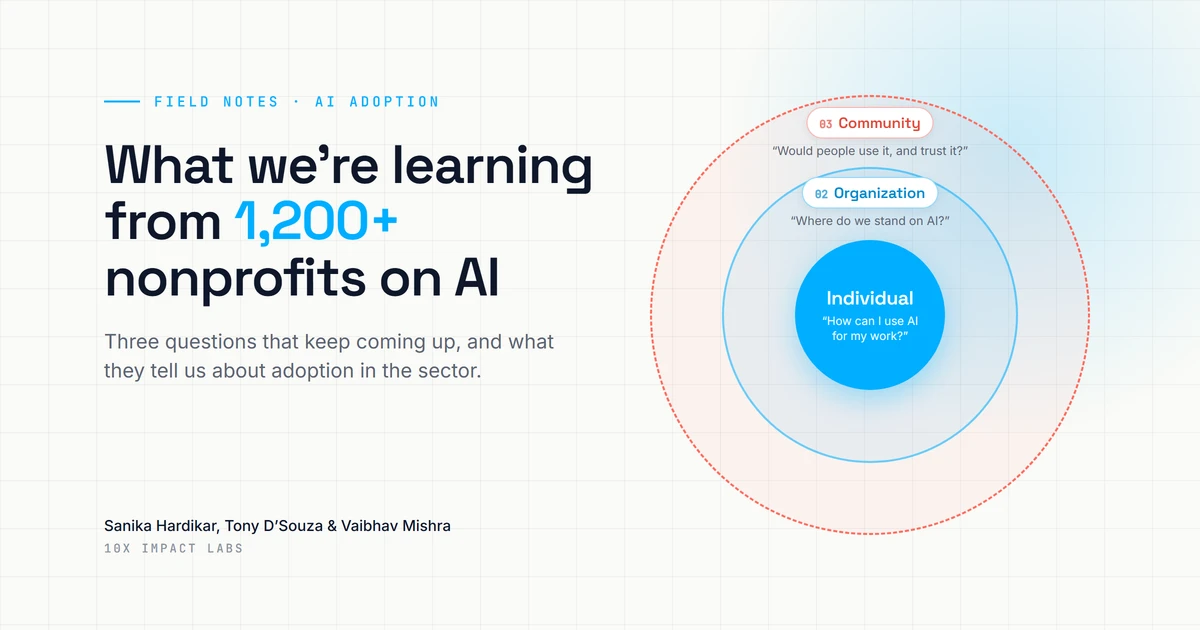
Working with nonprofits on AI, we have started paying more attention to how conversations begin, and what those beginnings reveal about the work.
Sometimes, a conversation starts with an individual wanting to do a task better, a leadership team trying to understand what AI means for the organization, or a program team wondering whether a new tool will actually improve the support it delivers to communities.
Each of them is turning to AI to solve a different problem, and we keep coming back to that difference. It has made us ask something the sector could ask more often.
When we talk about helping nonprofits adopt AI, whose question do we have in mind?
There is no shortage of opinion on AI in the impact sector, and much of it still asks whether nonprofits should adopt it. The questions nonprofits are already asking tell us more. They overlap, and also show how much AI adoption varies depending on who is using the technology, what they need from it and what their organization can support.
At 10x Impact Labs, we have trained more than 1,200 nonprofits to use AI, worked with over 20+ leadership teams to help them institutionalize it, and supported more than 30+ AI products built for communities. Across this work, we see three major layers of demand for AI.
Layer 1: When individuals ask, “How can I use AI for my work?”
It often starts with simple, practical questions about how AI can make everyday work easier or more efficient. In training sessions, people want to know which tools can help them write proposals, conduct research, prepare reports or manage data. Some teams need more specific help.
One impact measurement team we supported was developing theories of change for waste management and poultry enterprises, mapping pathways from inputs and activities to outputs, outcomes and long-term impact. The team also needed to frame questions about beneficiaries’ mental health and well-being in ways that were sensitive and non-intrusive. Using an AI co-pilot built for monitoring, evaluation and learning (ChatMnE), the team refined their frameworks through contextual follow-up questions, helping them work through these considerations while keeping the judgement with the people who understood the enterprises and their beneficiaries.
Safety questions come alongside these. Monitoring and evaluation teams ask whether beneficiary survey responses can be uploaded to AI tools for analysis. A team member can ask what is safe, but the answer depends on decisions about data, access and acceptable use that no individual can make alone. Those have to come from leadership, bringing the conversation from individual experimentation to the organization as a whole.
Layer 2: When AI becomes an organizational decision
At this point, the leadership question is no longer simply “Can my team use ChatGPT?” Often prompted by funders and boards, leaders want to understand where their organization stands and what work should look like in the age of AI. That includes policies and guardrails, budgets, priorities and the extent to which teams can experiment freely.
In our work with five incubator-backed nonprofits developing two-year technology, data and AI roadmaps, we watched leadership teams work through which opportunities deserved attention first, what to invest in, which risks needed planning and who would carry each step forward. Each organization left with a plan that connected technology decisions to its own priorities, along with a clearer sense of what would need to change for sustained AI usage.
Many nonprofits are still at an early stage with this. The Digital for Nonprofits 2026 report found that 85% of surveyed nonprofits used multiple generative AI tools, while only a quarter had safeguards around sensitive data.
Individual teams can grow comfortable with AI while the organization remains unsure how to use it consistently and responsibly.
The question changes again when AI becomes part of what a nonprofit delivers.
Layer 3: When AI reaches communities
A promising demonstration is only the beginning.
For over a year, we supported a cohort of Non-profits developing AI products across health, education, agriculture and livelihoods. Through field immersions, product testing and evaluation, the questions became much more practical.
Would the product work in the conditions for which it was designed? Would people use it, and trust it? Could it fit into existing ways of delivering services?
Answering these meant testing the assumptions behind each solution, observing how people interacted with it and identifying technical and responsible AI risks early enough to shape decisions. That evidence helped establish whether a solution could be built, changed or scaled.
Taken together, these experiences show that AI adoption happens across all three connected layers. It starts with how an employee uses a tool, but quickly raises organizational questions. And when AI becomes part of a product or service, the people using it also become part of this conversation.
Each level needs something different. Staff need practical guidance from leadership to use AI safely. Organizations need to make decisions that reflect how teams actually work. Products designed for communities need to be tested in the conditions where they will be used.
The organization matters as much as the question
A small rural nonprofit and a large urban one may both want to know how to use AI, while starting from very different places.
Budget is a useful proxy for readiness, though an incomplete one. Small nonprofits, with annual budgets under ₹2 crore, make up the largest group in India. From our observations, however, around 90% of them lack a tech-savvy person on staff, leaving no one internally who knows where to start.
A free tool does little if nobody can help a team use it well.
Mid-sized nonprofits, with budgets between ₹2 crore and ₹10 crore, may already use digital tools and need help connecting them to their data and processes. Larger nonprofits, with budgets between ₹10 crore and ₹100 crore, often have more established systems and face more complex questions of governance and coordination.
Geography matters too, as urban nonprofits tend to be fairly more tech-savvy than rural ones.
These differences are easy to overlook when AI adoption is treated as a one‑size‑fits‑all solution. A small rural nonprofit may need basic capacity before an AI pilot, while a larger one may be ready to integrate AI into existing processes.
In the end, we find ourselves returning to the questions that begin each conversation. What is someone trying to do better? What does the organization need to decide? What must a program establish before it can rely on a new solution?
These questions do not follow a fixed order. AI adoption in the nonprofit sector is not one problem, and it calls for more than one kind of support.
The first step is listening for which question is being asked, and by whom.